Why I Almost Paid Nine Times More for Malaria Treatment: A Lesson Every Traveler Needs Before Their Next Trip
When Jonathan Mugisha, a tourist and business traveler in Kampala, Uganda, was diagnosed with malaria, he paid UGX 35,000 for consultation and tests but was quoted UGX 257,000 for treatment. After the clinic refused to release his prescription, he used his lab results at an independent pharmacy and received treatment for UGX 30,000, making a full recovery. His experience highlights questions around malaria treatment costs in Uganda, hospital overcharging tourists and travelers, medical billing transparency, and patient rights abroad, and why travelers should request itemized bills and keep their medical records, while tour operators and DMCs can strengthen duty of care by pre-vetting trusted healthcare providers and sharing basic health guidance.
Why I Almost Paid Nine Times More for Malaria Treatment: A Lesson Every Traveler Needs Before Their Next Trip
By Jonathan Mugisha
Editor's note: The name of the clinic and staff involved have been withheld. This article is not about one facility. It is about a pattern that happens to travelers everywhere and what to do about it.
The Friday That Started It
It was one of the busiest Fridays of the month. By the time I got home, I was drained, but I still had one job left: confirm that a client's scheduled social media posts had gone live. I told myself thirty minutes, maybe less.
By 8 p.m. I was still at my laptop. My shoulder had started to ache in a way I couldn't place.
"My shoulder is aching," I told my wife. "Hopefully it's just fatigue."
She laughed it off. "You said you were checking the post for five minutes. What are you actually doing, writing an essay in Quillbot?"
By 9 p.m. I closed the laptop and went to bed. Fifteen minutes later, the fever hit. Then the headache. It was one of the longest, most painful nights I have had in years.
What I Tried Before I Went to a Clinic
This part matters, because it is what most travelers and busy professionals do before they seek real medical help, and it is exactly why the story that follows is so important.
Paracetamol, then later a stronger painkiller, to get through the night
Hibiscus tea in the morning, hoping it would help with fatigue
Aloe vera tea, which brought the fever down slightly but did nothing for the body pain
A visit to a pharmacy on Saturday, where I was given tablets and a warning: if this does not clear up, get checked.
None of it worked. The pain came back like clockwork every five hours, exactly when each dose wore off.
The Diagnosis and the Bill That Followed
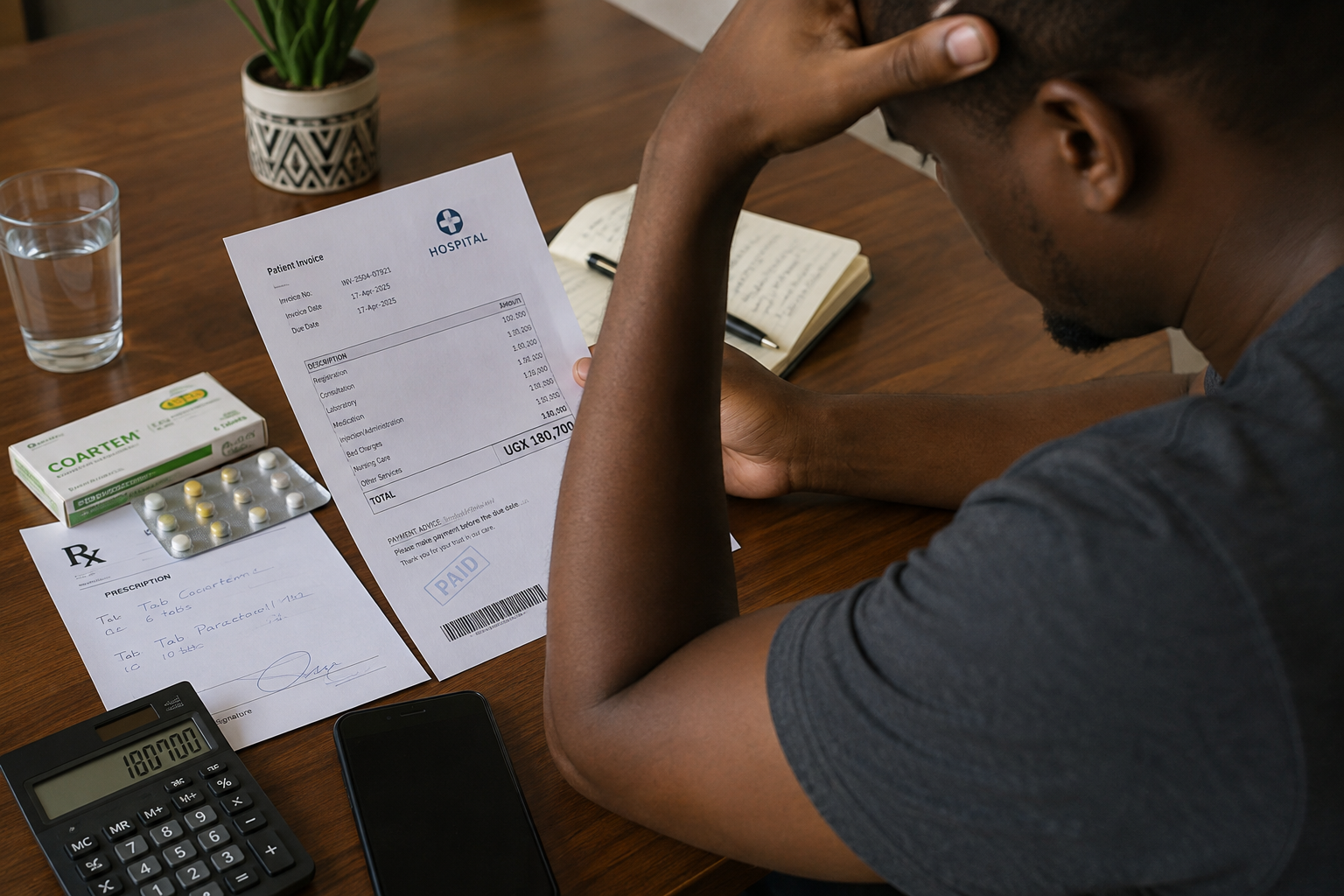
On Sunday, I walked into a medical center. The consultation cost 10,000 UGX. The full lab panel cost 25,000 UGX. Both were fair, and I want to be clear about that, because this story is not about the price of getting diagnosed.
The results confirmed malaria.
"Now that we know the issue," I asked the doctor, "what is the treatment plan?"
I was told to go to reception for the bill.
The quote for treatment and medication came to 257,000 UGX, roughly ten times what I ended up actually paying once I sourced the same prescription elsewhere.
The Standoff at the Reception Desk
I told the receptionist plainly: "I cannot afford this treatment plan, but I have already paid for the consultation and the lab work, so please give me the prescription, and I will source the medication myself."
She refused.
For a few minutes, I forgot I had malaria. What I felt instead was something closer to anger. I had paid in full for the diagnosis. The prescription was mine. Withholding it made no sense, unless the real product being sold was not the medicine but the captive customer.
I did not back down. I collected my lab results and receipts, and I left. At a separate pharmacy, using those same lab results, I bought the exact medication I needed for 30,000 UGX.
I am fully recovered now, cared for at home by my family, and 227,000 UGX richer than I would have been if I had simply accepted the first number I was given.
The Advice I Wish Someone Had Given Me
Healthcare should never be a trap for the desperate or the exhausted. Most clinics and hospitals operate honestly. But some will price a treatment plan based on how sick, how tired, or how far from home you look, not on what the medicine actually costs.
This is not just a Uganda story. It is a traveler's story. It happens in tourist towns, transit hubs, and roadside clinics on every continent, wherever a sick person is more likely to say yes without asking questions.
A Practical Checklist for Tourists and Road Trippers
If you are traveling, whether across Uganda or across the world, build these habits into your trip before you need them, not after.
Ask for an itemized bill before you agree to any treatment plan. A legitimate provider will break down consultation, tests, and medication separately, the way this clinic did for the first two items.
You are entitled to your prescription and your lab results once you have paid for them. No provider can legally withhold documents you have paid for. If they try, treat it as a red flag, not a technicality.
Compare the treatment quote against a second pharmacy before paying. A five-minute stop at another chemist, prescription in hand, can save you the majority of the cost.
Carry a basic travel health kit and know common symptoms for the region you are visiting. In malaria-endemic areas, know the signs: fever, chills, headache, and body aches that do not improve with rest or common painkillers within 24 to 48 hours.
Research reputable hospitals before you travel, not during an emergency. A quick search or a recommendation from your hotel or tour operator before you leave home puts you in a stronger position than searching while feverish.
Keep copies of every receipt and result. They are your leverage, and in my case, they were the reason I was still able to get treated properly after walking away.
What This Means for Tour Operators and Trip Planners
If you run tours, manage road trips, or plan travel itineraries, this story is a service gap you can close for your clients.
Pre-vet two or three hospitals in every region you operate in, and share that list with travelers before departure, not after symptoms appear.
Brief travelers on their rights as patients, specifically the right to an itemized bill and to their own prescription and lab results.
Build a small travel health card into your welcome packet: local emergency numbers, a vetted hospital, and a note on typical, fair costs for common ailments in the region, so a client has a benchmark to compare against on the spot.
Treat this as part of your duty of care. A client who overpays for treatment, or worse, avoids treatment because of cost fear, becomes a liability and a reputational risk for your operation.
Frequently Asked Questions
Is a clinic allowed to withhold my prescription if I've already paid for the consultation? No. Once you have paid for a consultation and diagnostic tests, the prescription and lab results are yours. A provider withholding them after payment is a warning sign, not standard practice.
How much should basic diagnosis and treatment for malaria cost? Costs vary by country and facility, but as a reference point, a consultation and lab panel together should typically be a modest, fixed fee, and antimalarial medication from a licensed pharmacy is generally affordable. Any quote that is dramatically higher than what the same medication costs at an independent pharmacy is worth questioning.
What should a tourist do if they feel a treatment plan is overpriced? Ask for an itemized breakdown, request your prescription and results, and get a second opinion or quote from another licensed pharmacy before agreeing to pay.
What are the early symptoms of malaria that travelers should watch for? Fever, chills, headache, fatigue, and body aches that do not improve after 24 to 48 hours of rest and basic over-the-counter medication. Persistent or worsening symptoms warrant a proper medical check and lab test, not just self-medication.
The Bottom Line
Healthcare should be accessible and fair. Most of it is. But vigilance is part of responsible travel, the same way checking your passport expiry or your travel insurance is. Ask questions. Get your documents. Compare your options. Your health, and your wallet, deserve that much.
If you are planning travel and want a vetted network of trusted healthcare providers, honest cost benchmarks, and travel safety guidance for your route, that is exactly the kind of support a platform like this exists to provide.
Share this Story
Share with preview image & title on social networks
Book This Expedition with Yellowstone Tour Operators
Contact the tour operator directly to inquire about dates, custom packages, or group bookings.